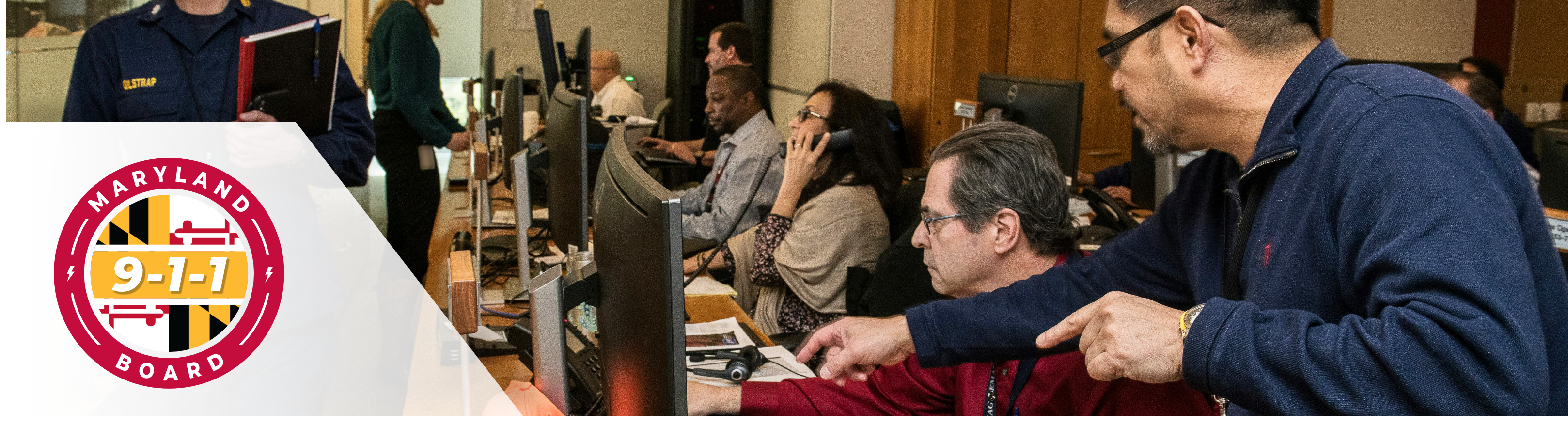
As technology has advanced, what Marylanders need from their 9-1-1 system has advanced as well. To keep up, Maryland Public Safety Answering Points (PSAPs) have transitioned to a
Next Generation 9-1-1 (NG9-1-1) system that's designed to fit the modern digital era.
Unlike legacy 9-1-1 systems, NG9-1-1 allows not only voice communication with a 9-1-1 specialist, but also gives Marylanders the chance to
contact 9-1-1 by texting, as well as send photos and videos of an emergency to help better inform the first responders who will be on their way to assist. Behind the scenes, NG9-1-1 also lets PSAPs in different counties and neighboring states collaborate and support each other much more easily.
Maryland's NG9-1-1 project began in 2017. Throughout 2018 to 2020, technicians and experts in Geographic Information Systems (GIS) built plans and prepared the necessary mapping and location datasets to make the system work. Implementation began in 2021, and as of 2026, all Maryland jurisdictions have successfully completed their transition to the NG9-1-1 system.
Now, no matter where you live, work, or travel in our state, NG9-1-1 is now available and ready to respond if you need it!
Benefits of NG9-1-1
What specifically does a NG9-1-1 system offer that legacy 9-1-1 didn't?
Maryland's move to a Next Generation 9-1-1 system provides your local PSAP with improved capacity for handling and processing 9-1-1 calls, managing the flow of larger amounts of data, and keeping better aware and up-to-date on the information surrounding any emergency someone may report.
Specifically, this includes benefits like....
- Improved accuracy when identifying the location of calls received from wireless devices like cell phones.
- The ability to route calls more efficiently based on the location of the caller's device.
- Dynamic routing, which lets PSAPs better manage call congestion and ensure your call gets through.
- Greater interoperability between PSAPs, so 9-1-1 dispatchers across county lines can work together more effectively.
- The ability to receive new forms of 9-1-1 requests, like text, video, and data.
- A more secure environment for communicating in an emergency, and a more resilient network to deliver and route your calls.
All of this means a 9-1-1 system that's
better equipped to meet the needs of today's 9-1-1 caller, texter, and beyond.
Who's Involved?
Meet the players who helped plan, implement, and operate the new NG9-1-1 system.
Making the transition to NG9-1-1 was far from an overnight process - it involved creating a statewide NG9-1-1 strategic plan, collecting and applying GIS data, building policies to govern the new features NG9-1-1 offers, and more. Accomplishing that to-do list takes multiple specialized groups working together, with each one's contributions critical to the success of the whole project.
Some of these groups include...
-
Maryland Emergency Communications Committee (ECC)
A group of the 24 state 911 directors as part of the Maryland Association of Counties' (MACo) Emergency Managers Affiliate. They serve Maryland counties by articulating the needs of local government to the Maryland General Assembly.
-
Maryland GIS Working Group
A working group consisting of GIS public safety professionals from Maryland's 24 jurisdictions.
-
Maryland 9-1-1 Board
That's us! The 9-1-1 Board (formerly the Emergency Number Systems Board) is the legislatively mandated custodian of the 911 Trust Fund, and provides oversight and direction to the 24 county PSAPs.
-
Commission to Advance NG9-1-1 Across Maryland
The Commission to Advance NG911 Across Maryland was legislatively created for a limited duration to provide recommendations to the Governor and Legislature for the implementation, finding, and governance of NG911. Their records and information are now available in the
Maryland State Archives.
-
Telecommunications Providers
NG9-1-1 systems use a data network called an Emergency Services IP Network (ESInet) to deliver call information securely to a PSAP. ESInets are provided by telecommunications companies, and each jurisdiction is empowered to choose the company that best suits their needs. Right now, the following companies have been chosen to provide county ESInets:
AT&T - serving Baltimore, Calvert, Caroline, Cecil, Charles, Dorchester, Harford, Kent, Montgomery, St. Mary's, Somerset, Talbot, Wicomico, and Worcester Counties
Motorola - serving Allegany, Anne Arundel, Carroll, Frederick, Garrett, Howard, Prince George's, and Washington Counties, and the City of Baltimore